Temple Themes in the Lives of Isaac, Jacob and Their Wives
- Stephen Fluckiger
- Apr 24
- 34 min read

How Joseph’s study of the scriptures, including his inspired “translation” of the Bible, contributed to the restoration of temple ordinances. In July 1830, the Lord commanded Joseph to “let your time be devoted to the studying of the scriptures” (D&C 26:1), a commandment that applies equally to us. The Lord knew that to properly understand the need for and purposes of temples, Joseph Smith needed to come to understand what we now know about them. Things about which the Christian world of Joseph’s day (and ours) knew nothing.

Joseph needed to learn, as General Handbook 27 succinctly tells us, that “since ancient times, whenever a faithful people has been on the earth, God has blessed them with temple ordinances and covenants.” In other words, God blessed Adam and Eve and their faithful posterity with temple ordinances. This posterity, of course, would include all the patriarchs we read about in the Bible and the Pearl of Great Price.
References to these ordinances, including “many of the covenants of the Lord” that are part of such ordinances, were “taken away” from the Bible, as Nephi affirmed (1 Nephi 13:26). But many echoes and intimations of the temple and its ordinances remain, as these blogs attest.
The Lord knew that as Joseph made the sacrifice of what would amount to years of diligent, even verse-be-verse, study of the Bible, questions would arise. Answers would then come. Line upon line, Joseph (and the Church) would be ready, finally, to receive and administer the sacred, divinely scripted words of the washing, anointing, clothing, endowment instruction and sealing ordinances.
For example, we learned in Part 4 of my Abraham blogs that as Joseph studied Genesis he noticed (as Elder Brigham Roberts observed) “the favor in which the Lord held” Abraham, Isaac and Jacob.[1] After all, as Joseph well knew, it is not a trifling thing to speak with the Lord “face to face” on one, yet alone, numerous occasions, as each of them did. Joseph’s impression about the intimacy of the Patriarchs’ relationships with Jehovah led to his question about plural marriage. That question, in turn, led to a revelation about the new and everlasting covenant of marriage, the sealing ordinance.
And so the revelatory process unfolded over the years.
How did Joseph learn about the Patriarchs and the quality of their relationship with Jehovah? We know that Joseph and Oliver purchased a copy of the King James Version of the Bible from E. B. Grandin on October 8, 1829. “It was this copy of the Bible that was used in the [Joseph Smith] translation.”[2]
As Joseph began studying the Book of Genesis in 1830 and continuing over the years thereafter, he obviously noticed the same things that we find in the text about how Abraham, Issac and Jacob felt about, interacted with and gave heed to Jehovah and His counsel and instructions. Joseph’s knowledge about Abraham would have increased tremendously, as does ours, as he translated the Book of Abraham in 1835 (including possibly using the Urim and Thummim).
But there is another historical account, related by Robert Matthews, that suggests how the Prophet’s gift of seership may have aided his understanding of these illustrious men (and their wives), including most importantly how their covenant relationship with Jehovah increasingly sanctified them throughout their lives.
Matthews cites an account or statement Joseph Smith made to Lorenzo Brown, probably in 1837, at his father’s [Benjamin Brown’s] home. Sidney Rigdon was also present. Joseph Smith told Lorenzo: “After I got through translating the Book of Mormon, I took up the Bible to read with the Urim and Thummim [Joseph’s seer stone]. I read the first chapter of Genesis and I saw the things as they were done. I turned over the next, and the whole passed before me like a grand panorama; and so on chapter after chapter until I read the whole of it. I saw it all!”[3]
In other words, as might have been the case when Joseph used his seer stone to assist in translating the ancient Egyptian papyri, Joseph not only had his divine gift of translation to call upon,[4] but his gift of seership. Consequently, he comprehended in very profound ways not only the words of the scriptures, but possibly many details about those events that are not included in the text.
The Divine Encounters of Isaac and Rebekah
As Joseph Smith studied (and revised or "translated") the accounts of the patriarchs and their families in Genesis and the Book of Abraham, he was receiving a masterclass on the antiquity of temple worship. Their experiences perfectly map the covenant path from initiatory prepatations, to endowment instructions and covenants, to the ultimate blessing of having one's calling and election made sure. Moreover, to fully understand the power of temple ordinances in the lives of the patriarchs, Abraham, Isaac and Jacob, we need to equally understand the power of temple ordinances in the lives of their wives, Sarah, Rebekah and Rachel.
Rebekah, an “Equal Partner” with Issac in the New and Everlasting Covenant of Marriage. Before her marriage to Issac, was Rebekah a “member of the Church,” so to speak? The Old Testament provides some clues. For example, we know that Abraham, according to President Nelson, was an “endowed” and “sealed” member of the “Church” as it was established in his day and time. Indeed, he was the head of a dispensation. When it came time for Isaac to be married, according to the traditions of his day, Abraham commanded his servant to “swear by the LORD, the God of heaven, and the God of the earth,” that he would “not take a wife unto my son of the daughters of the Canaanites, among whom I dwell.” Rather, Abraham commanded him to “go unto my country, and to my kindred,” indeed to his “father’s house,” “and take a wife unto my son Isaac” (Genesis 24:3-4, 38).[5] Why?
The Old Testament: Gospel Doctrine Teacher’s Manual explains simply that “Abraham wanted Isaac to marry someone of his own faith so he could marry in the covenant,” meaning a “temple marriage.”[6]
Rebecca not only witnessed but recognized the hand of “the Lord God of . . . Abraham” (Genesis 24:48) in leading Abraham’s servant to her. Abraham’s God was none other than Jehovah or Jesus Christ. In other words, Rebecca surely believed in the Savior. In her response to the Lord’s call to leave her family and assume the obligations of marriage, Rebecca signaled her spiritual maturity and obedience to the Lord’s will by responding simply, “I will go” (Genesis 24:58).
Abraham’s Marriage to Keturah and his Death. Issac was 40 when he married Rebekah (Genesis 25:20), which occured three years after his mother Sarah’s death. Abraham lived another 35 years. During these years he married Keturah and had six additional sons (Genesis 26:1-2). Jethro, the descendant of one of these sons, Midian,[7] received the priesthood through a line extending back to Esaias, a contemporary of Abraham. Indeed, while Esaias received the priesthood “under the hand of God,” Abraham “blessed” him, suggesting possibly an ecclesiastical relationship (D&C 84:6-13).
Abraham also witnessed the birth of Isaac’s sons, Esau and Jacob, who were fifteen when Abraham died.[8] As any faithful grandfather would, Abrham no doubt did everything he could, in concert with Isaac and Rebekah, to raise both his grandsons in the “nurture and admonition” of the Lord (Ephesians 6:4; Enos 1:1).
In recording the completion of Abraham’s august life, the writers of Genesis 25 wish “readers to understand that the great patriarch has finished his work on the earth quietly ‘in a good old age’ as ‘an old man, and full of years’ [175 in all] (v. 8). The sense of contentment and completion evoked by these words ‘is found with no other personality in biblical literature. The phrase describes not his longevity, which is otherwise mentioned, but the quality of his earthly existence.’ The final acts of his life,” including those summarized above, “are mentioned here as a fitting valedictory to the life of a humble, generous, and godly man, one of the greatest to have ever lived because he submitted his will to the Lord’s in every trial, including and especially in his willingness—against all reason, sense, and feeling—to sacrifice his beloved son Isaac.”[9]
God Warns Isaac and Renews the Abrahamic Covenant at Gerar. When another great famine arose, Isaac contemplated fleeing to Egypt, but “the Lord appeared unto him” and warned him to stay in the land. During this appearance, the Lord renewed the Abrahamic covenant directly with Isaac, promising to “be with thee” and to “bless thee.” “I will perform the oath which I sware unto Abraham thy father,” the Lord declared. Promising Isaac that He would “multiply thy seed” “as the stars of heaven” and give them the land “because that Abraham obeyed my voice, and kept my charge, my commandments, my statutes, and my laws” (Genesis 26:2-5).
Appearance at Beer-sheba. After facing conflict with the Philistines over water, Isaac moved to Beer-sheba. The “Lord appeared to him the same night” and reassured him: “I am the God of Abraham thy father: fear not, for I am with thee and will bless thee” (Genesis 26:24). Following this theophany, Isaac built an altar, as his father had done repeatedly before him, “and called upon the name of the Lord” (Genesis 26:25).
The Lord Reveals to Rebecca that Jacob Would Receive, and Directs Her to Command Jacob to Seek, the Birthright Blessing. As noted repeatedly in this study, President Nelson taught that Isaac and Rebecca were “sealed” in the new and everlasting covenant of marriage.[10] He reaffirmed this important doctrinal understanding when he declared that “Isaac and Rebekah’s son Jacob was born in the covenant” of that eternal marriage.[11]
Members of the Church are very familiar with the story of how Jacob convinces Esau to “sell” his birthright blessing for a “mess of pottage” (Genesis 25,headnote).[12] Likewise, we know well how Rebecca “commands” Jacob to “obey my voice” in deceiving his father into obtaining the birthright blessing (Genesis 27:8).
Bruce Porter provides another perspective on Rebekah’s actions based on her rights and responsibility as a matriarch in the new and everlasting covenant of marriage. Her rights and responsibilities in this sacred relationship are equal in importance to her husband’s rights and responsibilities as the patriarch. The “ancient patriarchal order consists of a husband and wife with equal power but divided responsibilities. The husband's duty was to administer the ordinances of salvation and exaltation to his family and posterity, setting apart a new patriarch for the extended family before his death. One of the wife’s responsibilities in this order of the priesthood would be to present, or ‘bear’ physically, as well as spiritually her children to the patriarch for his acceptance, naming, and blessing.”[13]
“Notably the Lord spoke to Rebekah, not Isaac, about which of her sons would receive the birthright or priesthood (Genesis 25:23). Thus, when she understands that Isaac has asked Esau to bring ‘savoury meat’ that Isaac may eat and bless his son before he dies, she knows that he is preparing for ‘a sacramental or ritual meal’ with which she is familiar and for which she then prepares Jacob, whom the Lord has entrusted her to prepare, throughout his life, for that which the Lord revealed he should receive.”[14]
“The ritual involves Isaac asking Jacob, ‘“Who are thou, my son?” or “what is your name?”’ Jacob responds by giving the first or given name of the firstborn, Esau, ‘as a key word to legitimize the blessing’ and perhaps other ‘signs of recognition’ (which right Jacob [received] from Esau previously). When Isaac invites Jacob to ‘“come near” (vs. 21) so that he may “feel” or touch Jacob’ to assure himself that he is prepared for the ritual for which Rebekah has prepared him, he appears to be testing the birthright son. ‘Come near now, and kiss me, my son,’ Isaac asks (Genesis. 27:26). ‘While in this mutual and ritual embrace Isaac surrenders to the signs he was looking for’ and proceeds to utter the inspired” blessing.[15]
Other scholars similarly have recognized in these “ritualized performances”—the preparation of a meal as a preliminary offering or sacrifice, the placement of hands on parts of the body, an exchange of questions identifying the petitioner, and the formal pronouncement of the blessing itself—ancient precursors to the initiatory washing, anointing, and clothing ordinances of the modern temple that Joseph Smith would have recognized as he engaged with the text. Furthermore, when Rebekah dressed Jacob in Esau's clothing to receive the blessing, Jewish traditions suggest she was dressing Jacob in Adam’s “wonderful garments”—specifically, the “high-priestly raiment.”[16]
From the perspective of Joseph Smith’s later Nauvoo-era teachings to the Relief Society sisters about the authority God would confer upon them in the endowment,[17] Porter’s conclusions about Rebekah’s actions are instructive:
The involvement of Rebekah in the blessing of Jacob was one of decision and responsibility, not deception, and should not be ignored in an interpretive exegesis of male and female relationships in Genesis. Likewise, we should not gloss over the involvement of the wives and mothers of patriarchs, prophets, and kings as recorded in ancient scripture. Only the mother can verify the father and lineage of the child. She alone may testify who her firstborn is, and to whom the birthright belongs. Thus, by revelation, Rebekah knew which child should receive the birthright. She then prepared and presented that son for the endowed blessing from his father when the time had arrived. With this matriarchal authority and right that Rebekah held, Isaac could not rebel against his wife, the presented son, or the inspired blessing given under his hand.[18]
The Lord characterized a woman’s matriarchal authority and responsibility in the new and everlasting covenant in very similar terms. Said He about His daughters’ roles in this “order of the priesthood” (D&C 131:2): in “bearing” and nurturing, physically and spiritually, “the souls of men,” “according to my commandment,” such daughters--
“Fulfil the promise which was given by my Father before the foundation of the world,” meaning the Father’s promise that each of us who kept our first estate would receive a physical body, have the opportunity to prove ourselves in our second estate, and receive a level of “salvation” in a kingdom of glory commensurate with such proving; and
Ensure “their”—referring to His daughters who so magnify their divine callings as wives and mothers—“exaltation in the eternal worlds, . . . for herein is the work of my Father continued, that he may be glorified” (D&C 132:63).
In furtherance of her matriarchal responsibilities and concerns, “Rebekah reminded Isaac that, notwithstanding all their efforts to raise their sons in the admonition and nurture of the Lord, if Jacob followed” Esau’s example in marrying outside the covenant, “her life would lose all meaning. ‘And Rebekah said to Isaac, I am weary of my life because of the daughters of Heth: if Jacob take a wife of the daughters of Heth, such as these which are of the daughters of the land, what good shall my life do me?’ (Genesis 27:46).”[19]
As Bruce R. McConkie put it, Rebekah “thought her whole life would be wasted if Jacob married out of the Church. She knew he could not enter the gate leading to exaltation unless he was married in the new and everlasting covenant of marriage, and so she brought the matter to Isaac’s attention. This, I think, is a great object lesson. The mother was greatly concerned about the [temple] marriage of her son, and she prevailed upon the father to do something about it. She was acting as a guide and a light to Isaac, as my wife often does to me.”[20]
Thus, Rebekah provides one of the greatest scriptural lessons of what it means to be an “equal partner” in the new and everlasting covenant of marriage. Husband and wife are equally yoked in helping one another fulfill their divinely appointed roles, including as father and mother, to keep, and help their children keep, each and every law, rite and ordinance of the gospel, including most importantly the ordinances of the temple.
The Divine Encounters of Jacob
Jacob’s spiritual journey perfectly mirrors the trajectory of the covenant path: departing from our heavenly home, ascending through stages of instruction and testing, and ultimately returning to the presence of God.[21] In “contrast [to his brother Esau], Jacob trifled not with sacred things (see D&C 6:12). He chose to obey his mother and father in many things and ultimately set out on a journey to seek a wife from among a known and acceptable branch of the covenant family.”[22]
Andrew Skinner suggests that Rebekah’s prophetic premonition that the “nations” that would come from her younger son, Jacob, would have “ascendancy” over the nations that would come from her older son (Genesis 25:23) could be attributed to Jacob’s premortal faithfulness. As the Lord had revealed to Abraham, certain premortal spirits were more “noble” or faithful than others (Abraham 3:22). Jacob’s “soberness and obedience were qualities that had been developed, nurtured, and proven over and over throughout the long eons of a premortal existence and thus lay at the heart of Jehovah’s promise to Rebekah of Jacob’s future greatness (see Genesis 25:23–26).”[23]
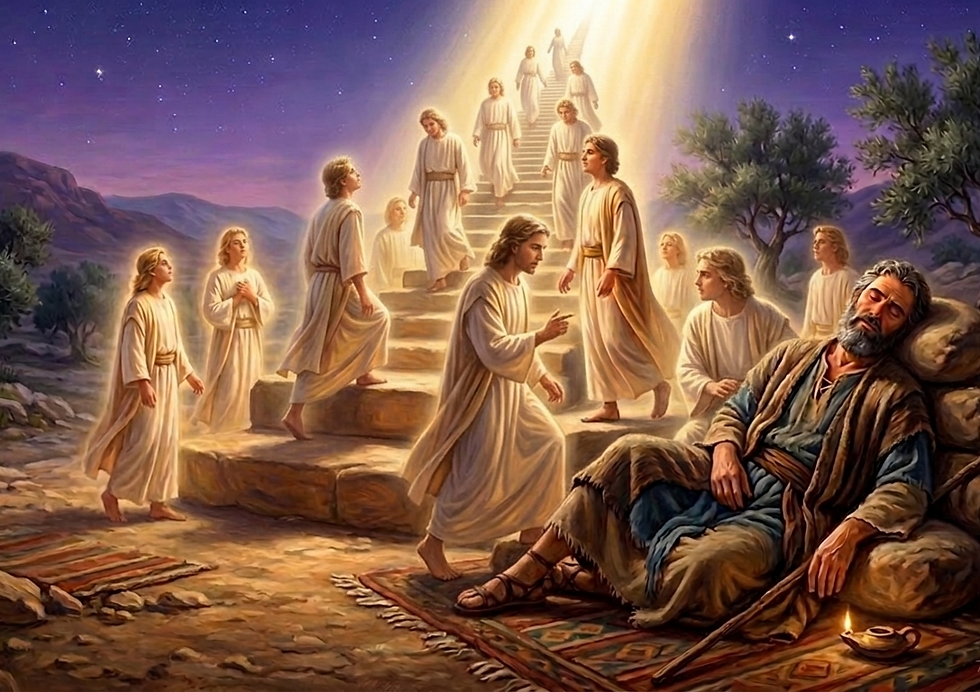
The First Vision at Bethel: The Ladder of Heavenly Ascent (Genesis 28:10–17). While fleeing from the wrath of Esau on his way to Haran, Jacob stopped to sleep at “a certain place” he would later name Beth-el (Hebrew for “House of God”) (Genesis 28: 11, 19). This is “a place of instruction (Genesis 28:16-17) and covenant-making (Genesis 28:20-21).” Here he experienced a profound dream of a “ladder set up on the earth, and the top of it reached to heaven” (Genesis 28:12). Bradshaw notes that this “ladder” is best understood as a staged temple-tower or a “vast ramp with terraced landings.” The angels ascending and descending were “presumably . . . ascending and descending in order to give Jacob specific messages and instruction,” a pattern that endowed Latter-day Saints will instantly recognize.[24]
“Already [by] 1832,” Bradshaw notes, as he carried out his inspired translation of Genesis, the Prophet Joseph Smith “had correlated” Jacob’s experience, symbolized by the ladder, with the “mysteries of godliness,” meaning specifically the sacred truths taught in temples.[25] Thus, Andrew Skinner concludes, because the Melchizedek Priesthood holds the “key of the mysteries” (D&C 84:19), Jacob must have been a “a righteous Melchizedek Priesthood holder.”[26]
Moreover, the Prophet correlated the “three principal rounds of Jacob’s ladder” with principles associated in the endowment with “the telestial, the terrestrial, and the celestial glories or kingdoms.”[27] Patrons of the Salt Lake and other late nineteenth-century temples symbolically experienced such progression as they moved through multiple instruction rooms, then through the veil into the celestial room.[28]
At Bethel, Jacob made covenants mirroring those of the modern temple, specifically the law of tithing, which is part of the law of consecration. “If God will be with me, and will keep me in this way that I go, and will give me bread to eat, and raiment to put on,” then “all that thou shalt give me I will surely give the tenth unto thee” (Genesis 28:19-22).
Emphasizing the sacredness of Beth-el, Jewish tradition holds that Jacob literally laid “upon the eventual site of the . . . Holy of Holies.”[29] Given all “the associations to the endowment, it is likely that ‘Jacob received his endowment at Bethel’ as part of the sacred experience recorded in Genesis 28.”[30]
Theophany at Peniel: A Ritual Embrace (Genesis 32:24–30). Thirteen children later and approaching his one hundredth birthday,[31] “the LORD said unto Jacob, Return unto the land of thy fathers, and to thy kindred” (Genesis 31:3). As all worthy, sealed husbands should, he then counsels with his wives, Rachel and Leah. “In a dream,” he tells them how “the angel of God spake unto” him, instructing him about his flocks (that is, his job or occupation). Speaking by divine investiture (“I am the God of Beth-el)”, the angel instructs: “now arise, get thee out from this land, and return unto the land of thy kindred” (Genesis 31:4-13). Rachel and Leah respond, “now then, whatsoever God hath said unto thee, do” (Genesis 31:16).
As they neared the Promised Land, Jacob faced a terrifying reunion with his estranged brother, Esau. Skinner suggests that “the threat of a vengeful brother probably cannot be overestimated, for it was a life crisis of staggering proportion. In Jacob’s mind, his family, as well as the covenant itself, faced annihilation.” It was “a test of a lifetime, an Abrahamic test of complexity and contradiction."[32]
In response, Jacob poured out his soul in humble, earnest prayer. “I am not worthy of the least of all the mercies, and of all the truth, which thou hast shewed unto thy servant” (Genesis 32:10). Alone, Jacob “wrestled” with a divine messenger until daybreak.[33]
And Jacob was left alone; and there wrestled a man with him until the breaking of the day. And when he [the messenger] saw that he prevailed not against [Jacob], he touched the hollow of his thigh; and the hollow of Jacob's thigh was out of joint, as he wrestled with him (Genesis 32:24-25).
Commentators cite Hugh Nibley's noteworthy insight on this event: the Hebrew word conventionally translated as “wrestled” (yē’āvēq) can just as accurately mean “embrace.”
And [the messenger] said, Let me go, for the day breaketh. And [Jacob] said, I will not let thee go, except thou bless me.
And [the messenger] said unto him, What is thy name? And he said, Jacob.
And [the messenger] said, Thy name shall be called no more Jacob, but Israel: for as a prince hast thou power with God and with men, and hast prevailed.
And Jacob asked him, and said, Tell me, I pray thee, thy name. And he said, Wherefore is it that thou dost ask after my name? And he blessed him there.
And Jacob called the name of the place Peniel: for I have seen God face to face, and my life is preserved (Genesis 32:25-30).
“The sequence of events up to this point,” Skinner notes, “is clear:
1) Jacob wrestled all night for a blessing in the face of great trial, in which he, his family, and the fulfillment of the covenant all faced annihilation.
2) Jacob was asked for his name, and he disclosed his own given name to a divine being or minister.
3) Jacob was then presented with a new name.
4 Jacob was next given an endowment of power, which would be recognized in the eyes of both God and men.
5) Jacob was finally given an additional blessing, and the divine being was not heard from again.”
The Biblical record does not explain the nature of the “blessing” with which the divine messenger “blessed” Jacob “there” (Genesis 32:29). “We get only Jacob’s response to the blessing bestowed upon him at that moment. But what an arresting response it was, for it tells us what we may read into the narrative. The text says, ‘And he [the divine being] blessed him there. . . . And Jacob called the name of the place Peniel: for I have seen God face to face, and my life is preserved' (Genesis 32:29–30).
"Let there be no misunderstanding; the text says Jacob was blessed, and then the very next words out of his mouth which are (or, perhaps, can be) reported to us are, ‘I have seen God face to face, and my life is preserved’ (Genesis 32:30). Thus, the great blessing Jacob received that night was no less than the ultimate theophany of his (or anyone’s) life—his being privileged to enjoy the literal presence of God and to have every promise of past years sealed and confirmed upon him him.”[34]
Promises Made Sure: Second Divine Encounter and Confirmation at Beth-el (Genesis 35:1–15). God spoke again to Jacob after his return to Caanan. “Arise, go up to Bethel, and dwell there: and make there an altar unto God, that appeared unto thee when thou fleddest from the face of Esau thy brother (Genesis 35:1). Exemplary patriarch that he was, Jacob (no doubt in concert with his wives) “said unto his household, and to all that were with him, Put away the strange gods that are among you, and be clean, and change your garments: And let us arise, and go up to Bethel; and I will make there an altar unto God” (Genesis 35:2-3).
Or, as Hugh Nibley described God’s instruction, “he was to establish a holy society, a little Zion.” When his family and those members of the Church, we could say, who “were with him” were ready, Jacob, in Nibley’s paraphrase of verse 3, said “Let us arise and go up to the house of the Lord, and there I will make a sacrifice to the God who answered me in the day of my distress” (cf. Genesis 35:3).[35]
Jacob, like Moses after him, appreciated the importance of initiatory or ritual preparations that work to “sanctify” (Exodus 40:13) or prepare us for divine instruction and covenant-making, including “putting “off” our shoes and changing from our street clothes into sacred clothing used exclusively on “holy [temple] ground[s]” (Exodus 3:5). Jacob’s family went to the house of the Lord to participate in a sacred ordinance. “So Jacob came to Luz, which is in the land of Canaan, that is, Bethel, he and all the people that were with him” (Genesis 35:6).
While the record is cryptic, it appears that sometime later (after Deborah, Rebekah’s nurse dies as recorded in verse 8), “God appeared unto Jacob again, . . . and blessed him.”
And God said unto him, Thy name is Jacob: thy name shall not be called any more Jacob, but Israel shall be thy name: and he called his name Israel. And God said unto him, I am God Almighty: be fruitful and multiply; a nation and a company of nations shall be of thee, and kings shall come out of thy loins; And the land which I gave Abraham and Isaac, to thee I will give it . . . And God went up from him in the place where he talked with him (Genesis 35:9-13).
Significantly, this second divine encounter at Beth-el is not merely a repeat of his previous dream; rather, it is a “direct confirmation or ratification of Jacob’s earlier temple-related blessings.” While his first experience Beth-el involved an angelic minister, this time, God personally appeared to Jacob, confirming his new name, Israel, for a second time and “making his promises sure.”[36] According to Jewish tradition, during this confirmation, God brought Jacob into the heavenly temple, showing him “one story above another, and . . . the chambers of the supernal realms.”[37]
Entering Their Exaltation
By charting these encounters across the lives of Abraham, Isaac, and Jacob and their wives, a magnificent pattern emerges. God does not merely issue commandments from afar; He comes down to deliver, to covenant, to reveal the cosmos, and to grant new names and priesthood power.
Jehovah, speaking through Isaiah, spoke to the importance of these ancient couples when He said: “Look unto Abraham your father, and unto Sarah that bare you: for I called him alone, and blessed him, and increased him” (Isaiah 51:2).
It is significant to me that throughout the scriptures the Lord refers to Himself as “the God of Abraham, Isaac and Jacob.”[38]
Why single them out for this recognition?
For these patriarchs and their wives, the ultimate spiritual treasure was to literally behold the face of God and have His promises sealed upon them. Because they received these ordinances and “did none other things than that which they were commanded, they have entered into their exaltation, according to the promises, and sit upon thrones, and are not angels but are gods” (D&C 132:37). In the clearest way possible, the Savior has commanded us, “Go ye, therefore, and do the works of Abraham; enter ye into my law and ye shall be saved” (D&C 132:32).
Specifically, what “works” of Abraham, Isaac and Jacob should we do? The Lord asks us to “enter into my law.” This means receiving the ordinances of the temple and keeping the covenants that we make there.
Joseph Smith elaborated on this theme in his explanation of the Apostle Paul’s encouragement to the Saints of his day to “be not slothful” but through “faith and patience” seek the “promises” of eternal life made to Abraham (Hebrews 6:12-13, 18-20):
I admit that, by reading the scriptures of truth, saints in the days of Paul could learn beyond the power of contradiction that Abraham, Isaac, and Jacob had the promise of eternal life confirmed to them by an oath of the Lord, but that promise or oath was no assurance to them of their salvation. But they could, by walking in the footsteps and continuing in the faith of their fathers, obtain for themselves an oath for confirmation that they were meet to be partakers of [such promises].[39]
Expressly speaking on behalf of Jesus Christ (which modern prophets rarely do), President Nelson in 2021 listed five crucial challenges the Savior has issued to help us in our own pursuit of these precious temple promises.
The first challenge was directed to him as the Prophet and the other members of the First Presidency and Quorum of the Twelve Apostles. “The Lord,” President Nelson reported, had impressed upon them the importance of “ensur[ing] worldwide accuracy and consistency of temple instruction, covenants, and ordinances despite differences in language and culture.” In furtherance of this mandate, we have seen (and, I believe, will continue to see) God continually adjusting temple ordinances since 1842 and the ways in which they are administered in response to the needs and understanding of His faithful children.
The next four challenges (or commandments) the Savior directed to each temple-worthy and temple-attending member of the Church. President Nelson declared that—
1. Jesus Christ "is the One who wants you to understand with great clarity exactly what you are making covenants to do.” 2. “He is the One who wants you to experience fully His sacred ordinances.” 3. “He wants you to comprehend your privileges, promises, and responsibilities.” 4. “He wants you to have spiritual insights and awakenings you’ve never had before. This He desires for all temple patrons, no matter where they live.”[35]
Through his inspired translation of Genesis and the Egyptian papyri, Joseph Smith’s mind was opened to the ancient “order of the priesthood” (D&C 131:2) and the “blessings of the fathers” that Abraham and his posterity “sought” and “desired” so ardently (Abraham 1:2). Likewise, through our diligent study of these sacred texts, we can increase our “comprehension” of our temple “privileges, promises, and responsibilities.” As the Lord was preparing Joseph Smith to restore these crowning blessings, He can prepare us to “have spiritual insights and awakenings” about our temple blessings we have not had before.
[1] Fluckiger, “Abraham and the “Promises” of the Temple—Part 4,” https://www.temple-spiritual-treasures.com/post/abraham-and-the-promises-of-the-temple-part-4, note 3, citing Matthews, “A Plainer Translation”: Joseph Smith’s Translation of the Bible, 257-58.
[2] Matthews, “A Plainer Translation”: Joseph Smith’s Translation of the Bible, 26.
[3] Ibid., 25-26 & note 12, quoting from “Sayings of Joseph, but Those Who Heard Him at Different Times” in the Joseph Smith, Jr. Papers in the Church Historical Library, Manuscript Section.
[4] See Fluckiger, “Joseph Smith and Oliver Cowdery—Translation and the ‘Spirit of Revelation,’” text accompanying and note 24, https://www.temple-spiritual-treasures.com/post/joseph-smith-and-oliver-cowdery-translation-and-the-spirit-of-revelation.
[5] Fluckiger, 305.
[6] Old Testament: Gospel Doctrine Teacher’s Manual (Salt Lake City, Utah: The Church of Jesus Christ of Latter-day Saints, 2001), https://www.churchofjesuschrist.org/study/manual/old-testament-gospel-doctrine-teachers-manual/lesson-10?lang=eng.
[7] Nibley cites sources that state that “the Midianites into whose people Moses married were
Kenites.” “The Kenites were those people ‘concerning whose territory a covenant was made with Abraham, and who have not yet been conquered [by the Egyptians]’ —that is, of all the vast area described as Abraham’s heritage in the Genesis Apocryphon. The rabbis identified Kenite country with the deserts stretching all the way from the southern tip of Arabia to Asia Minor.” An Approach to the Book of Abraham, 317-18 & note 561.
[8] Fluckiger, 307.
[9] Jeffrey M. Bradshaw, “Old Testament Commentary - Genesis 25-27: Jacob Takes Center Stage among the Descendants of Abraham,” Interpreter Foundation, https://interpreterfoundation.org/cfm-commentary-genesis-25-27.
[10] Fluckiger, 307, citing Nelson, “The Everlasting Covenant.” See also Nelson, “Come, Follow Me.”
[11] Ibid.
[12] In his commentary on Genesis 25:29, Bradshaw notes that when “when Esau came from the field, and he was faint,” there may have been “more to the story of the sale of Esau’s birthright to Jacob than is recorded in the Bible. According to Jewish lore summarized by Hugh Nibley, ‘Nimrod had [the garment of the priesthood]; then Esau was jealous of Nimrod, who was another great hunter. He lay in ambush, slew Nimrod, took the garment from him, and… ran exhausted to Jacob… [This garment was the birthright which Jacob got from Esau.] That was the deal: he was willing to sell it in a financial sense.”
Bradshaw goes on to show how Esau’s conversation with Jacob, in Hebrew--“Feed me, I pray thee, with that same red pottage; for I am faint” (Genesis 25:30)—"give us what we need to see into Esau’s heart. It is well known that in biblical dialogue all the characters speak proper literary Hebrew, with no intimations of slang, dialect, or ideolect. The single striking exception is impatient Esau’s first speech to Jacob in Genesis 25: ‘Let me gulp down some of this red red stuff.’ Inarticulate with hunger, he cannot come up with the ordinary Hebrew term for ‘stew,’ and so he makes do with ha’adom ha’adom hazeh—literally ‘this red red.’ But what is more interesting for our purpose is the verb Esau uses for ‘feeding,’ hal’iteini. This is the sole occurrence of this verb in the biblical corpus, but in the Talmud it is a commonly used term with the specific meaning of stuffing food into the mouth of an animal.… [I]n this instance, the writer . . . exceptionally allowed himself to introduce the vernacular term for animal feeding in order to suggest Esau’s coarsely appetitive character. The rapid-fire description in verse 34 of Esau’s subsequent behavior (‘he did eat and drink, and rose up, and went his way’) ‘nicely expresses the precipitous manner in which Esau gulps down his food and, as the verse concludes, casts away his birthright.’” Bradshaw, “Old Testament Commentary - Genesis 25-27.”
[13] Fluckiger, 318 note 4, citing Bruce Porter, “Deception vs. Decision, Matriarchal Authority and Patriarchal Responsibility,” https://www.bhporter.net/deception-vs-decision.
[14] Ibid. Compare Bradshaw, “Old Testament Commentary - Genesis 25-27,” citing Josephus, who claimed that “it was Isaac rather than Rebekah who enquired and received the answer that the elder would serve the younger.”
[15] Fluckiger, 318 note 4, citing Porter, “Deception vs. Decision.” Bradshaw notes that “Isaac’s blessing [‘God give thee of the dew of heaven’] does not convey the birthright itself. ‘Apparently, [the blessing and the birthright] were separate institutions. Nothing is said [by Isaac] about the disposition of property’ in the blessing received in [Genesis 27:] 27–29 as would have been the case had it been a birthright blessing.” Bradshaw, “Old Testament Commentary - Genesis 25-27,” citing Nahum M. Sarna, ed. Genesis. The JPS Torah Commentary (Philadelphia, PA: The Jewish Publication Society, 1989), 189. Issac gave the birthright blessing later, after Rebekah reminded him that, despite their desire that both their sons marry in the covenant, Esau had chosen not to, which was a sore disappointment to Rebekah. “I am weary of my life because of the daughters of Heth” (Genesis 27:46). See text accompanying note 20, below. Andrew Skinner, on the other hand, sees both of Isaac’s blessings, including the second in which he “reconfirmed” the promises made in the first blessing, as conditional: “Isaac blessed him in accordance with patriarchal privileges and reconfirmed to him the opportunity of receiving the blessings and covenant of Abraham.” Andrew C. Skinner, “Jacob in the Presence of God,” Sperry Symposium Classics: The Old Testament, ed. Paul Y. Hoskisson (Provo and Salt Lake City, Utah: Religious Studies Center, Brigham Young University and Deseret Book), 117–32, https://rsc.byu.edu/sperry-symposium-classics-old-testament/jacob-presence-god.
[16] Bradshaw, “Old Testament Commentary - Genesis 25-27,” citing Louis Ginzberg, The Legends of the Jews (Baltimore, MD: Johns Hopkins University, 1998), I:332. See also David E. Bokovoy, “From the Hand of Jacob: A Ritual Analysis of Genesis 27,” Studies in the Bible and Antiquity 1 (2009), 35–50, https://scholarsarchive.byu.edu/sba/vol1/iss1/3/.
[17] Nauvoo Relief Society, “A Book of Records, Containing the proceedings of The Female Relief Society of Nauvoo,” Minute Book, 17 Mar. 1842–16 Mar. 1844, JSP, https://www.josephsmithpapers.org/paper-summary/nauvoo-relief-society-minute-book/36#source-note (teaching the sisters that the Relief Society should move forward according to the ancient order of the Priesthood and that he was "going to make of this Society a kingdom of priests [and priestesses] as in Enoch’s day— as in Paul’s day" and that they must be prepared for the blessings God had in store for them in the Temple); see also Gospel Topics Essays, “Joseph Smith’s Teachings about Priesthood, Temples, and Women,” https://www.churchofjesuschrist.org/study/manual/gospel-topics-essays/joseph-smiths-teachings-about-priesthood-temple-and-women?lang=eng (the Prophet’s organization of the Relief Society “was done to prepare the Saints to participate in the ordinances of the temple, which were introduced soon after the founding of the Relief Society. At the time of his death, the revelatory vision imparted to Joseph Smith was securely in place: women and men could receive and administer sacred priesthood ordinances in holy temples, which would help prepare them to enter the presence of God one day.”).
[18] Fluckiger, 318 note 4, citing Porter, “Deception vs. Decision.” Porter’s perspective is clearly not how most commentators view these events. Bradshaw, for example, cites BYU professor Arthur Henry King, who “noted that even though ‘Esau was obviously wrong, [in selling his birthright] does not mean that Jacob is right. Jacob’s mother had no doubt already told him about God’s promise that he would receive the birthright, and his attempt to buy it from Esau was not merely unnecessary but also an offensive vote of no confidence in the Lord. Besides, although ‘the gift of God’ may be sold, it cannot ‘be purchased.’” Bradshaw, “Old Testament Commentary - Genesis 25-27.”
[19] Fluckiger, 311.
[20] Ibid, quoting Bruce R. McConkie, Conference Report, Sydney Australia Area Conference 1976, as cited in Old Testament Instructor’s Guide, Religion 301–2, 34–35, https://www.churchofjesuschrist.org/study/manual/old-testament-instructors-guide/genesis-24–36?lang=eng. In the chronology of events recorded in Genesis, it is noteworthy that immediately after Rebekah “reminds” Isaac about his responsibility to do everything in his power to help Jacob “chose” to marry in the temple, so to speak, Issac immediately “called Jacob, and blessed him, and charged him, and said unto him, Thou shalt not take a wife of the daughters of Canaan. Arise, go to Padan-aram, to the house of Bethuel thy mother's father; and take thee a wife from thence of the daughters of Laban thy mother's brother” (Genesis 28:1-2). In other words, go where there are members of the Church so you can find a faithful, temple-worthy woman to marry. We do not know, of course, whether anyone in Padan-aram held the sealing power. But whether Jacob and his wives were sealed at the time of their “civil” marriage or sometime later is unimportant, given the Lord’s statement that Jacob has received his exaltation, meaning that he must have been sealed (D&C 132:37).
The father’s or patriarchal blessing Issac then administers to Jacob included the birthright promises: “And God Almighty bless thee, and make thee fruitful, and multiply thee, that thou mayest be a multitude of people; And give thee the blessing of Abraham, to thee, and to thy seed with thee; that thou mayest inherit the land wherein thou art a stranger, which God gave unto Abraham” (Genesis 28:3-4).
[21] “The story of Adam and Eve’s departure from the Garden of Eden and their return to the presence of God parallels a common pattern in ancient Near Eastern writings: departure from home, mission abroad, and happy homecoming. . . . To the ancients, however, it was more than a mere storytelling convention, since it reflected a sequence of events common in widespread temple ritual practices for priests and kings. More generally, it is the story of the plan of salvation in miniature, as seen from the personal perspective. . . . The general trajectory of departure and return along the covenant pathway is mirrored both spiritually and geographically in the story of Jacob (Hebrew “may God protect”). Taking leave of his family in Beersheba (Hebrew “well of the oath”—figuratively, the source of the covenant), he travels north and east by way of Beth-el (Hebrew “House of God”—a place of instruction about the covenant) to Haran (Hebrew charran = “Mountainous”—a place of testing for Jacob). Leaving Haran, Jacob at last returns to Beth-el, where God’s previous promises are made sure. Each major step of the way along Jacob’s personal covenant path, his experiences are remarkably infused with temple themes.” Jeffrey M. Bradshaw, “Old Testament Commentary - Genesis 28-31:'In His Own Time, and in His Own Way’ –Part 1 of 3: Jacob Ascends the Ladder of Exaltation,” https://interpreterfoundation.org/study/old-testament-commentary-old-testament-commentary-genesis-28-31-in-his-own-time-and-in-his-own-way-part-1-of-3-jacob-ascends-the-ladder-of-exaltation.
[22] Skinner, “Jacob in the Presence of God.”
[24] Bradshaw, “Old Testament Commentary - Genesis 28-31: ‘In His Own Time, and in His Own Way’ –Part 1 of 3 (“the early Christian idea of a ladder of virtues, inspired by Jacob’s dream, was a symbol of the process of spiritual progression that corresponds to the Latter-day Saint idea of progression toward eternal life through the making and keeping of covenants”).
[26] Skinner, “Jacob in the Presence of God.” [27] Bradshaw, “Old Testament Commentary - Genesis 28-31: ‘In His Own Time, and in His Own Way’ –Part 1 of 3.
During his temple experience, or “endowment,” I noted in Spiritual Treasures of the Temple, “the Lord’s promises to ‘be with’ and ‘keep [Jacob] in all places whither thou goest,’ and ‘not leave thee’ [Genesis 28:15] are the same promises he extends to us in the temple. ‘Above the stairway and through the gate, the Lord stood, waiting to receive Jacob into his kingdom, but first the stairway had to be climbed and the gate passed. . . . The temple is a stairway. We must climb it in order to reach our Father in Heaven. Everything in the Church funnels us toward the stairway and encourages us to climb. The climb will require effort, but even the effort is rewarding. The temple is also a gate. We must pass through it or forever remain outside the kingdom of God.’” Fluckiger 313, quoting S. Michael Wilcox, House of Glory: Finding Personal Meaning in the Temple (Salt Lake City, Utah: Deseret Book, 1995),103-04.
“Just as God renewed the Abrahamic covenant with Jacob, those portions of the Abrahamic covenant ‘which pertain to personal exaltation and eternal increase are renewed with each member of the House of Israel who enters the order of celestial marriage.’” Fluckiger, 313, quoting Hardison, 170–71, and McConkie, Mormon Doctrine, 13.
[28] Richard O. Cowan, describing the ongoing revelation that has (and always will) characterize the administration of temples and temple ordinances, noted that “the pattern of separate ordinance rooms was first seen in the Endowment House, dedicated in 1855. After receiving the preliminary ordinances and instructions, one would pass successively through the garden [representing the Garden of Eden before the Fall], world [representing this world or the telestial kingdom], and terrestrial rooms [representing the terrestrial kingdom]. All were located on the ground floor, and each was one step higher than the preceding room. One would then ascend a stairway to the second floor where the celestial room [representing the celestial kingdom] and sealing rooms were found.” Elder James E. Talmage, Brother Cowan wrote, explained the need for these and other “adjustments” in temple architecture and ordinances this way: “While the general purpose of temples is the same in all times, the special suitability of these edifices is determined by the needs of the dispensation to which they severally belong.” Richard O. Cowan, Temples Dot the Earth (Cove Fort, 1997), 82. For discussion of modern adjustments in temple ordinances, see Fluckiger, 113-14 and note 26 (including changes in ceremonial clothing, participation in temple ordinances by youth and recent converts, young men holding the Aaronic Priesthood office of priest officiating in proxy baptisms and youth serving as witnesses in proxy baptisms).
[29] Bradshaw, “Old Testament Commentary - Genesis 28-31.” (“Of course, the identification of Beth-el with Moriah and Jerusalem wreaks havoc on historical geography. But if we take the idea to be typological—or perhaps literal if there was a ‘temple’ of some kind at Beth-el at some point in Israel’s history, Beth-el became a holy place for Jacob”).
[30] Fluckiger, 313-14, quoting Skinner, “Jacob in the Presence of God.” President Marion G. Romney echoed this conclusion when, after recounting Jacob’s experience at Bethel (“a contraction of Beth-Elohim, which means literally ‘the House of the Lord’”), he taught that “temples,” where we are endowed, “are to us all what Bethel was to Jacob.” Marion G. Romney, “Temples—The Gates to Heaven,” Ensign, March 1971, https://www.churchofjesuschrist.org/study/ensign/1971/03/temples-the-gates-to-heaven?lang=eng.
[31] Fluckiger, 316, citing Skousen, Third Thousand Years, 54 note 96. [32] Skinner, “Jacob in the Presence of God.”
[33] One commentator notes that “while the wrestling between Jacob and this angel is represented as a physical struggle, this may be metaphorical for the exhaustive spiritual wrestlings that precede the greatest blessings from God.” Fluckiger, quoting Hardison, 172-73. President Brigham Young likewise suggested that “all of us are situated ‘upon the same ground’ [as Jacob], in that we must ‘struggle, wrestle, and strive, until the Lord bursts the veil and suffers us to behold His glory, or a portion of it.’” Skinner, “Jacob in the Presence of God,” 117–32. In Skinner’s view, however, “Jacob’s wrestle was physical as well as spiritual, because the text is emphatic in its description of Jacob’s dislocated hip (see Genesis 32:25, 31-32). Perhaps that detail is mentioned precisely to show that his wrestle was a literal as well as a metaphoric occurrence. It is also reasonable to suppose that Jacob’s opponent that night was a being from the unseen world of heavenly messengers, a divine minister possessing a tangible but translated body, because he was able to wrestle all night and throw Jacob’s hip out of joint (see Genesis 32:24-25).”
Nibley, on the other hand, opined that scholars who suggest that “the man” with whom Jabob wrestled “until the breaking of the day” in Genesis 32:24-29 was an angel (or translated being) miss the mark:
Next comes his wrestling with the Lord, which so perplexed the doctors that they changed the Lord to an angel, but “when one considers that the word conventionally translated as ‘wrestled’ (yēʾāvēq) can just as well mean ‘embrace’ and that it was in this ritual embrace that Jacob received a new name and the bestowal of priestly and kingly power at sunrise (Genesis 32:24–30),” the dawn of a new day, there is plainly more here than the doctors perceived.
Nibley, On the Sacred and the Symbolic,” 384.
[34] Skinner, “Jacob in the Presence of God,” 146. For a discussion of the temple ordinance (sometimes referred to as the “fulness of the priesthood” or “second anointing” ordinance) suggested by Jacob’s “face to face” encounter with God (Genesis 32:30), see Fluckiger, 279-87.
Bradshaw states that the “ritual aspects” of Jacob’s “struggle,” in which he is “named and blessed” with “the bestowal of priestly and kingly power at sunrise (Gen. 32:24–30)” suggest that Jacob’s encounter with God at Peniel was more than the type of “struggle” that Enos experienced. However, citing Rabbinic sources, Bradshaw comments that the text is unclear “as to whether Jacob received or not, at that time, either the new name he sought or the blessing he had requested.” According to the Jewish midrash, “at Jabbok Jacob received a new name only in anticipation of a new name he would receive later from God Himself: ‘It was not … the angel who was now renaming Jacob; nor was this name-change to be effective immediately, for the angel did not say, “no longer shall your name be called Jacob.” The angel was merely revealing to Jacob what God Himself would do later. . . . “For later on, the Holy One, Blessed be He, will reveal Himself to you in Beth-el [see Genesis 35:10]. There He will change your name and bless you.”’” Jeffrey M. Bradshaw, “Old Testament Commentary - Genesis 32-33:20: ‘In His Own Time, and in His Own Way’ Part 2 of 3: Jacob’s Wrestle with an Angel and Promise of a New Name,” https://interpreterfoundation.org/old-testament-commentary-genesis-32-3320-jacobs-wrestle-with-an-angel-and-promise-of-a-new-name.
[35] Hugh Nibley, “On the Sacred and the Symbolic,” in Eloquent Witness: Nibley on Himself, Others, and the Temple (Maxwell Institute Publications, 2008), 385, https://scholarsarchive.byu.edu/mi/28.
[36] To the question about the nature of the “man” with whom Jacob wrestled (see note 94 above), Skinner concludes: In light of Jacob’s theophany at Jabbok and/or Beth-el, “the other, and likely, possibility regarding the identity of Jacob’s visitor is that it was God Himself. Not Jehovah—for He did not yet possess a physical body. Rather, it would have been God the Father or Elohim. . . . [T]he term ‘man (Hebrew, ‘ish) used in Genesis 32:24 to describe Jacob’s visitor, was a word sometimes used anciently to refer to God. In fact, the ancient rabbis believed that ‘man’ was one of the many titles of God [“Man of Holiness (Moses 6:67)]. In addition, the phrase ‘face to face’ (Hebrew, panim ‘el panim) occurs several times in the Hebrew Bible, each referring to a heavenly vision, and only once does God not perform the visitation. In the end, one supposes it could be argued that the identity of Jacob’s visitor is not so important as the fact that the result of the visit was that the patriarch ultimately saw God and came to know that he had seen Him.” Skinner, “Jacob in the Presence of God.”
[37] Bradshaw, “Old Testament Commentary Part 1” and Jeffrey M. Bradshaw, “Old Testament Commentary - Genesis 34–35:1–15: ‘In His Own Time, and in His Own Way’ Part 3 of 3: Jacob’s Ascent to the Heavenly Temple,” https://interpreterfoundation.org/study/old-testament-commentary-genesis-34-351-15-jacobs-ascent-to-the-heavenly-temple.
[38] “I am the God of thy father, the God of Abraham, the God of Isaac, and the God of Jacob” (Exodus 3:6, 15, 16; Exodus 4:5; 1Chron. 29:18; 2 Chron. 30:6); “And it came to pass at the time of the offering of the evening sacrifice, that Elijah the prophet came near, and said, LORD God of Abraham, Isaac, and of Israel, let it be known this day that thou art God” (1 Kings 18:36 ); “The princes of the people are gathered together, even the people of the God of Abraham” (Psalms 47:9); “Have ye not read in the book of Moses, how in the bush God spake unto him, saying, I am the God of Abraham, and the God of Isaac, and the God of Jacob?” (Mark 12:26; Luke 20:37); “When Moses saw [fire in a bush], he wondered at the sight: and as he drew near to behold it, the voice of the Lord came unto him, Saying, I am the God of thy fathers, the God of Abraham, and the God of Isaac, and the God of Jacob” (Acts 7:31-32);” “The God of Abraham, and of Isaac, and of Jacob, the God of our fathers, hath glorified his Son Jesus; whom ye delivered up” (Act 3:13); “For the fulness of mine intent is that I may persuade men to come unto the God of Abraham, and the God of Isaac, and the God of Jacob, and be saved” (1 Nephi 6:4); “And the God of our fathers, who were led out of Egypt, out of bondage, and also were preserved in the wilderness by him, yea, the God of Abraham, and of Isaac, and the God of Jacob, yieldeth himself, according to the words of the angel, as a man, into the hands of wicked men, to be lifted up, according to the words of Zenock, and to be crucified, according to the words of Neum, and to be buried in a sepulchre, according to the words of Zenos” (1 Nephi 19:10; Mosiah 7:19; 23:23; Alma 29:11; 36:2); “May the God of Abraham, and the God of Isaac, and the God of Jacob, protect this people in righteousness, so long as they shall call on the name of their God for protection” (3 Nephi 4:30); “But behold, I will show unto you a God of miracles, even the God of Abraham, and the God of Isaac, and the God of Jacob; and it is that same God who created the heavens and the earth, and all things that in them are. Behold he created Adam” (Mormon 9:11-12); “Keep yourselves from evil to take the name of the Lord in vain, for I am the Lord your God, even the God of your fathers, the God of Abraham and of Isaac and of Jacob. I am he who led the children of Israel out of the land of Egypt; and my arm is stretched out in the last days, to save my people Israel (D&C 136:21-22). [39] Joseph Smith letter to his Uncle Silas, September 26, 1833 (J. Smith, Jr., Writings 2002), 188 note 332, as quoted in Jeffrey M. Bradshaw, Temple Themes in the Oath and Covenant of the Priesthood (Eborn Books Salt Lake City, 2014), https://archive.org/details/151128TempleThemesInTheOathAndCovenantOfThePriesthood2014Update/page/n1/mode/2up.
[40] Russell M. Nelson, “The Temple and Your Spiritual Foundation,” Liahona, November 2021, 94-95. President Nelson was also clear, as so many other prophets have been, that “the blessings of the Abrahamic covenant are conferred in holy temples” and in no other place. “These blessings allow us, upon being resurrected, to ‘inherit thrones, kingdoms, powers, principalities, and dominions, to our ‘exaltation and glory in all things’ [D&C 132:19].” Ibid., citing Russell M. Nelson, “Special Witnesses of Christ,” Liahona, April 2001, 7.
Remembering the incomprehensible Abrahamic “blessings” conferred upon us in the temple may be easier than remembering and understanding the specific covenants we make in the endowment and sealing ordinances. Of course, those blessings, so eloquently listed by the Lord in D&C 132:18-21 are conditional. The key phrase for me in that long, lawyer-like verse 19 (after all Christ is not only an advocate but our Advocate) is this: “if ye abide in my covenant.” As I have observed elsewhere:
The best source of information about the covenants and promises made and received in the new and everlasting covenant of marriage is the revealed language of the ordinance itself. Couples who are preparing to be sealed would be wise, either before, if possible, or soon after their sealing to participate as patrons in proxy sealings to be able to hear and ponder the inspired and inspiring covenants and promises contained in the sealing ordinances for both the sealing of husbands
and wives and children to parents.
Fluckiger, 262. Suffice it for these purposes to say that it behooves all of us to consider the important glosses the Lord gives us in the temple upon what it means to be “willing to take upon them the name of thy Son, and always remember him and keep his commandments which he has given them” (D&C 20:77). These glosses or additional instructions we receive in the temple, of course, include the five specific covenants we make in the endowment, which the Lord has graciously instructed His leaders to make accessible to us in the General Handbook, 27.2. It would be well for us to also ponder and make sure we understand all laws, rites, and ordinances we are under covenant to keep as members of the holy order of the priesthood. See generally Fluckiger, 261-70.


Comments