Christ Restores the Authority to Baptize

CFM Commentators on Isaiah, Temple Allusions and Joseph Smith's Line-upon-Line Tutoring. John Hilton, one of Scripture Central’s podcasters, made a historical connection in Isaiah 22 for me that I had not previously understood, illustrating how trustworthy mentors can enhance our understanding of the scriptures and the temple.

In Isaiah 22:20-25, the Lord calls “Eliakim, the son of Hilkiah” to replace Shebna, a wicked Israelite official (22:13; 37:2), whom Isaiah prophesies will fall (22:17-19). Hilton (and other commentators)[1] point out that Eliakim (as the headnote to chapter 22 states) is a type of the “Messiah” or Christ:
And I will clothe him [Eliakim/Christ] with thy [Shebna’s] robe, and strengthen him with thy girdle, and I will commit thy government into his hand: and he [Eliakim/Christ] shall be a father to the inhabitants of Jerusalem, and to the house of Judah.
And the key of the house of David will I lay upon his shoulder; so he shall open, and none shall shut; and he shall shut, and none shall open. [Compare Rev. 3:7 (Christ “hath the key of David”)
And I will fasten him as a nail in a sure place; and he shall be for a glorious throne to his father's house.
And they shall hang upon him [Christ] all the glory of his father's house . . . all vessels of small quantity [and large].
In that day, saith the LORD of hosts, shall the nail that is fastened in the sure place be removed, and be cut down, and fall; and the burden that was upon it shall be cut off: for the LORD hath spoken it.
“In its original context,” Hilton comments, “this passage tells us that Eliakim was a key part of the king's royal court. Imagine a nail or a peg in a wall with all sorts of important things hanging on that peg. That's Eliakim. We can see Jesus Christ in that same way. We as individuals and the gospel as a whole hang on him.”[2]
Elder Jeffrey R. Holland, Hilton notes, then connects Isaiah’s allusion to Christ as a “nail in a sure place” to temple doctrine familiar to every endowed member of the Church:
When the Roman soldiers drove their four-and-one-half-inch crucifixion spikes into their victim’s flesh, they did so first in the open palm. But because the weight of the body might tear that flesh and not sustain the burden to be carried, they also drove nails into the wrist, down in the nexus of bones and sinews that would not tear no matter what the weight. Thus, the nail in the wrist was the “nail in a sure place.” Once it was removed and the Savior was “cut down,” the burden of the crucified body (more literally, the burden of the Atonement) was brought to an end. In terms of our salvation, Christ is the Nail in a Sure Place—never failing, never faltering, ever the most certain and reliable force in eternity. For this, we surely “hang upon him all the glory of his father’s house.”[3]
In the same way we can gain soul-stirring insights (including about the temple) in our scripture study by turning to Church leaders and other trustworthy sources, Joseph Smith’s understanding of the temple and the indispensable role of its ordinances in God’s plan of salvation unfolded line upon line. Time and again, when Joseph and Oliver Cowdery encountered a new doctrine, such as the necessity of baptism performed by proper divine authority, they turned to God for direction. Their pattern of searching the scriptures, pondering sacred truths, and taking their earnest questions to Heavenly Father provides a timeless model for our own gospel learning.
Priesthood Authority and the Temple. The story of the restoration of the priesthood and the importance of the baptisms and ordinations that Joseph Smith and Oliver Cowdery administered to one another is familiar to virtually every member of the Church. But what do these events have to do with the temple?
The short answer is, “everything.” For example, the temple is all about receiving priesthood authority—both as men and women. When we renew our baptismal covenant each week, we re-covenant with the Father that we are “willing” to take upon us the name of Christ (D&C 20:77). As President Oaks has taught, this means that we solemnly agree to fully take upon us the Savior’s authority, to take up His cross and His work, to be initiated into the mysteries (doctrines and ordinances) of His holy “order”—meaning, ultimately, “the new and everlasting covenant of marriage” (D&C 131:2).[4]
We do this in the context of a ritual drama reenacting the Father’s plan, which centers on ordinances and covenants. These were taught and administered in the beginning to Adam and Eve. After exercising faith in Jesus Christ unto repentance (demonstrated by Adam and Eve’s obedience—even without fully understanding it—to the law of sacrifice), the very first ordinance they received was baptism (Moses 6:64-65). Baptism, as even our youth know, is temple doctrine (and, for the dead who were not baptized in mortality, a temple ordinance). It is part of the Law of the Gospel of Jesus Christ.[5]
Joseph and Oliver Learn the Need for and Authority Required to Baptize. What did Joseph Smith and Oliver Cowdery know about the ordinance of baptism and the priesthood authority required to administer it before the appearance of John the Baptist to them on May 15, 1829? Quite a bit. During his first visit on September 22, 1823, Moroni told Joseph that “when [the plates] are interpreted the Lord will give the holy priesthood to some, and they shall begin to proclaim the gospel and baptize by water, and after that they shall have power to give the Holy Ghost by the laying on of hands.”[6]
As Oliver transcribed Joseph’s divine “interpretation” of the plates, they would often discuss what they were learning.[7] Bushman in his biography asserts that “they paused occasionally to talk over the unfolding story of the Nephites.”[8] MacKay and Dirkmaat concluded that “Joseph and Oliver paid careful attention to the text that was miraculously written upon the seer stones that Oliver recorded in the burgeoning Book of Mormon manuscript.” Indeed, “Joseph had wondered about authority and baptism for years.”[9]
For example, in his 1838 history, Joseph Smith recorded that as he and Oliver continued to translate, “a difference of opinion [arose] between us about the account of John the Apostle, mentioned in the New Testament . . . whether he died or continued to live, [which] we mutually agreed to settle . . . by the Urim and Thummim.”[10] The Joseph Smith Papers editors note that Joseph and Oliver’s “discussion of this issue possibly arose when they encountered a passage in the translation of the plates describing the biblical prophet Moses and the Book of Mormon prophet Alma as having been ‘taken up by the spirit, or buried by the hand of the Lord.’”[11]
Richard Bennett, quoting Joseph F. Smith, the Prophet’s nephew, describes their understandable excitement about the things they were learning: “They became ‘animated over the truths and glorious promises unfolded to them in their work, and desired to reach out after these blessings.’ Yet the Lord ‘gently admonished them not to be in a hurray; he said: ‘You must wait yet a little while, for ye are not yet ordained.’”[12]
During the previous five weeks, Joseph received and Oliver transcribed numerous accounts about the doctrine of baptism and the authority necessary to perform it from the plates. As historian William G. Hartley points out, the Book of Mormon served as Joseph Smith’s “first primer on priesthood and how it functioned in ancient times.”[13] Translating day after day through the records of Mosiah, Alma, Helaman, and early 3 Nephi, Joseph and Oliver encountered a continuous stream of accounts detailing baptism, priesthood ordinations, and sacred authority.[14]
Joseph dictated, Oliver transcribing, for instance, the account of King Limhi’s people, who were “desirous to be baptized,” “but there was none in the land that had authority from God” (Mosiah 21:33). Because they lacked authority, “they did not at that time form themselves into a church” (Mosiah 21:34). On the other hand, Alma, “having authority from the Almighty God,” baptized Helam and over two hundred souls at the Waters of Mormon (Mosiah 18:13). As “high priest” of the “church of Christ” (Mosiah 18:17), “none received authority to preach or to teach except it were by [Alma as presiding high priest] from God” (Mosiah 23:17).
Moving through the record of Alma, Joseph declared, as he saw or received spiritual impressions through the Interpreter(s), and Oliver heard and wrote masterful doctrinal discourses on the Nephite “holy order of God” (2 Nephi 6:2; Alma 5:44, 54; 6:8; 7:22; 8:4; 13:1, 6, 8, 10-11, 18; 43:2; 49:30). What impressions might have entered their hearts as they pondered Mormon’s description and Alma’s explanations about the “high priesthood of” or “after” or “according to” “the holy order of God” or “of his Son.” Learning about “ordination” to this priesthood, which was “without beginning of days or end of years, being prepared from eternity to all eternity,” and by which “the children of men” could “enter into” the “rest” of God, surely fired their hearts with desire (Alma 4:20; 13:6-8, 10, 14, 18).
As Hartley notes, Joseph Smith “firmly believed” and treated neither “casually” nor “lightly” the Book of Mormon’s teachings about priesthood.[15]
After Translating 3 Nephi, Joseph and Oliver Pray about “Baptism for the Remission of Sins.” According to Welch's chronology of the Book of Mormon translation, between May 10 and May 15 Joseph and Oliver translated 3 Nephi 1 through 18.[16] As Joseph quoted the resurrected Savior declaring to Nephi3 “I give unto you power that ye shall baptize this people” (3 Nephi 11:21), their hearts no doubt burned. Then as they visualized this scene, with the word “baptize” (and its derivatives, including the word “immerse”) appearing some 46 times in these chapters, surely no doubt remained in their minds as to their need to be baptized.
“My doctrine,” the Lord unequivocally declared, “which the Father hath given me,” is this—
Whoso believeth in me, and is baptized, the same shall be saved; and they are they who shall inherit the kingdom of God. And whoso believeth not in me, and is not baptized, shall be damned (3 Nephi 11:33-34).
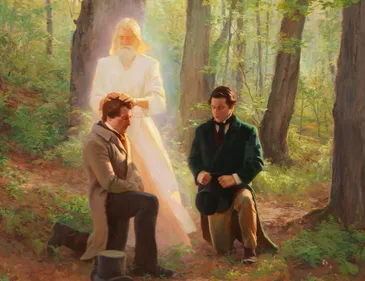
What happened next, historians note, Joseph and Oliver would not record until years later. For one thing, their sensitivity to the need to keep records of these all-important events would grow incrementally. Not until the organization of the Church, on April 6, 1830, would the Lord reveal, “Behold, there shall be a record kept among you” (D&C 20:1).
Moreover, from the first hostile reaction he received after sharing his experience of the first vision with a Methodist Preacher,[17] to the almost constant persecution that accompanied his stewardship over the plates, as well Moroni’s sometimes very direct tutoring about keeping sacred things sacred,[18] the 23-year-old Prophet had acquired what historians describe as a deliberate spiritual reserve—sharing his personal manifestations only when commanded, in sacred contexts, or with trusted confidants.[19]
Oliver Cowdery was first to offer a detailed, written account of John the Baptist’s visit in a 1834 letter to William W. Phelps.
After writing the account given of the Savior’s ministry to the remnant of the seed of Jacob, upon this continent, it was easily to be seen, as the prophet said would be, that darkness covered the earth and gross darkness the minds of the people. On reflecting further, it was as easily to be seen, that amid the great strife and noise concerning religion, none had authority from God to administer the ordinances of the gospel. For, the q[u]estion might be asked, have men authority to administer in the name of Christ, who deny revelations? . . . If these facts were buried, and carefully concealed by men whose craft would have been in danger, if once permitted to shine in the faces of men, they were no longer to us; and we only waited for the commandment to be given, “Arise and be baptized.”
This was not long desired before it was realized. The Lord, who is rich in mercy, and ever willing to answer the consistent prayer of the humble, after we had called upon him in a fervent manner, aside from the abodes of men, condescended to manifest to us his will. On a sudden, as from the midst of eternity, the voice of the Redeemer spake peace to us, while the vail was parted and the angel of God came down clothed with glory, and delivered the anxiously looked for message, and the keys of the gospel of repentance. What joy! what wonder! what amazement! While the world was racked and distracted—while millions were grouping [groping] as the blind for the wall, and while all men were resting upon uncertainty, as a general mass, our eyes beheld—our ears heard. As in the “blaze of day;” yes, more—above the glitter of the May Sun beam, which then shed its brilliancy over the face of nature! Then his voice, though mild, pierced to the center, and his words, “I am thy fellow-servant,” dispelled every fear. We listened—we gazed—we admired! ’Twas the voice of an angel from glory—’twas a message from the Most High! and as we heard we rejoiced, while his love enkindled upon our souls, and we were rapt in the vision of the Almighty! Where was room for doubt? No where; uncertainty had fled, doubt had sunk, no more to rise, while fiction and deception had fled forever!
But, dear brother think, further think for a moment, what joy filled our hearts, and with what surprise we must have bowed, (for who would not have bowed the knee for such a blessing?) when we received under his hand the holy priesthood as he said, “upon you my fellow servants, in the name of Messiah I confer this priesthood and this authority, which shall remain upon earth, that the Sons of Levi may yet offer an offering unto the Lord in righteousness!” . . . The assurance that we were in the presence of an angel; the certainty that we heard the voice of Jesus, and the truth unsullied as it flowed from a pure personage, dictated by the will of God, is to me, past description.[20]
Brian Q. Cannon, former Chair of the BYU History Department, notes that “the following year, Cowdery specified the date and location of the restoration of the Aaronic Priesthood.”[21]
Joseph Smith’s first attempt to describe the earliest events of the restoration[22] included a record of his receiving “the holy Priesthood by the ministring of— Aangels [sic] to adminster the letter of the Law <Gospel—> <—the Law and commandments as they were given unto him—> and in <the> ordinencs.”[23]
In April 1838, the Prophet, assisted by his counselor, Sidney Rigdon,[24] provided his fullest account of the event, “corroborat[ing] Oliver’s record and add[ing] new details: for instance, Joseph recorded words used by John regarding the nature of the keys that he bestowed; explained that John had acted under the direction of Peter, James, and John; and indicated that John promised them that later they would receive power to bestow the gift of the Holy Ghost.”[25]
In . . . (May, Eighteen hundred and twenty nine) we on a certain day went into the woods to pray and inquire of the Lord respecting baptism for the remission of sins as we found mentioned in the translation of the plates. While we were thus employed praying and calling upon the Lord, a Messenger from heaven, descended in a cloud of light, and having laid his hands upon us, he ordained us, saying unto us; “Upon you my fellow servants in the name of Messiah I confer the priesthood of Aaron, which holds the keys of the ministring of angels and of the gospel of repentance, and of baptism by immersion for the remission of sins, and this shall never be taken again from the earth, untill the sons of Levi do offer again an offering unto the Lord in righteousness.” He said this Aaronic priesthood had not the power of laying on of hands, for the gift of the Holy Ghost, but that this should be conferred on <us> hereafter and he commanded us to go and be baptized, and gave us directions that I should baptize Oliver Cowdery, and afterward that he should baptize me.
. . . .
The messenger who visited us on this occasion and conferred this priesthood upon us said that his name was John, the same that is called John the Baptist in the new Testament, and that he acted under the direction <of> Peter, James, and John, who held the keys of the priesthood of Melchisedeck, whi[c]h priesthood he said should in due time be conferred on us. <And that I should be called the first Elder of the Church and he the second.> . . .
. . . we were forced to keep secret the circumstances of our having been baptized, and having received this priesthood; owing to a spirit of persecution which had already manifested itself in the neighborhood.[26]
Following their ordinations under the hands of the resurrected John the Baptist, the two young men repaired to the nearby waters of the Susquehanna River and baptized one another. As directed by the angel, Joseph first baptized Oliver. Oliver then baptized Joseph. They then laid their hands upon each other to re-ordain one another to the Aaronic Priesthood.[27]
Joseph recalled that as soon as they came up out of the water, “we experienced great and glorious blessings from our Heavenly Father.” After their baptisms, they each stood and, by the power of the Holy Ghost, prophesied concerning the “rise of this Church, and many other things connected with the Church, and this generation of the children of men” (JS-H 1:73).
Reflecting on his ordination years later in Nauvoo, Joseph explained that John the Baptist had been sent as “the Spirit of Elias,” conferring a preparatory authority to preach repentance and baptize with water, while promising that the higher authority to lay on hands for the gift of the Holy Ghost would be bestowed in “due time.”[28]
For the remainder of his life, Oliver Cowdery bore solemn, unwavering testimony of the authority he received from the “angel from glory,” declaring to a congregation in 1848 shortly before his death: “I was present with Joseph when an holy angle from god came own from heaven and confered or restored the Aronic priesthood. . . . for the angel said unto Joseph Smith Jr., in my hearing, that this priesthood shall remain on earth unto the end.”[29]
What Are the “Keys of the Ministering of Angels?” When John the Baptist told Joseph and Oliver as he conferred upon them the Aaronic Priesthood that this priesthood authority held “the keys of the ministering of angels,” it must have seemed perfectly natural. After all, it was a real-life angel, a resurrected being, who was ministering to them. (Not to mention the numerous visits Joseph received from the resurrected Moroni.)
But what does this mean to us? And, perhaps more importantly to the parents and grandparents of Aaronic Priesthood age young men, what does it mean to them?
In a later 1832 revelation on priesthood, the Lord would repeat to the Prophet (and the Church) that “the lesser priesthood . . . holdeth the key of the ministering of angels and the preparatory gospel; Which gospel is the gospel of repentance and of baptism, and the remission of sins” (D&C 84:26–27).
President Dallin H. Oaks explained how the ordinance of the sacrament—generally administered by holders of the Aaronic Priesthood—unlocks the key for all members to receive the ministry of angels. President Oaks pointed out that when partaking of the sacrament is preceded by repentance, it becomes not only a renewal of the covenants of baptism, but the blessings of baptism—the remission of sins.[30]
In the sacramental prayer over the bread, the Lord promises that those who keep their covenants—in essence engaging in this ongoing process of what President Nelson referred to as “daily” repentance[31]—will “always have his Spirit to be with them” (D&C 20:77).
How does this promise relate to the “ministering of angels”? President Oaks observed that the promise of having the Spirit of the Lord “refers not only to the Holy Ghost but also to the ministering of angels, for ‘angels speak by the power of the Holy Ghost; wherefore, they speak the words of Christ’ (2 Nephi 32:3).”[32] Just as being clean enables us to dwell in God’s presence, the cleansing ordinances of baptism and the weekly sacrament, accompanied by the constant application of the principle of repentance, prepare Saints to enjoy both the constant companionship of the Holy Ghost and the ministering of angels.[33]
Angels, the leaders of the church have frequently taught, can both be seen and unseen.[34] “Angelic messages can be delivered by a voice or merely by thoughts or feelings communicated to the mind,” President Oaks observed. Quoting President John Taylor, he described such angelic messages from “angels, or messengers of God, upon our minds, so that the heart can conceive,” or understand, the message sent “from the eternal world.”[35]
President Oaks’ and President Taylor’s doctrinal explanations suggest to me that the sources of all spiritual direction and promptings we receive are not attributable to some abstract principle or force, but to real spiritual beings, all of whom ultimately act under the direction of God the Father.[36]
Who Are the “Sons of Levi” and What “Offering” Will They Offer in Righteousness? Would Joseph Smith have heard the phrase “Sons of Levi” prior to John the Baptist’s statement that the priesthood he was conferring upon him and Oliver “shall never be taken again from the earth, until the sons of Levi do offer again an offering unto the Lord in righteousness” (D&C 13:1; see also Malachi 3:1–3; 3 Nephi 24:1–3)?
Yes. Recall that Moroni first quoted to Joseph five times during the evening and morning of September 21-22, 1823 “part of the third chapter of Malachi” (JS-History 1:36).[37]
This revelation (which Jospeh would likely have had occasion to revisit many times thereafter) states:
Behold, I will send my messenger, and he shall prepare the way before me: and the Lord, whom ye seek, shall suddenly come to his temple, even the messenger of the covenant, whom ye delight in: behold, he shall come, saith the LORD of hosts.
But who may abide the day of his coming? and who shall stand when he appeareth? for he is like a refiner's fire, and like fullers' soap:
And he shall sit as a refiner and purifer of silver: and he shall purify the sons of Levi, and purge them as gold and silver, that they may offer unto the LORD an offering in righteousness (Malachi 3:1-3)(emphasis added).
Latter-day Saint scholars have pointed out the profound significance of this connection. When John the Baptist placed his hands upon Joseph and Oliver in May 1829, the references to Levi and temple offerings were not merely historical allusions to Levite animal sacrifices made in the ancient Tabernacle and Solomon’s Temple. Rather, the angelic messenger was explicitly echoing and fulfilling the very temple prophecy from Malachi 3:3 that Moroni had impressed upon the boy prophet five times in twenty-four hours six years earlier.
As scholars A. Keith Thompson and Jeffrey M. Bradshaw observe, this direct continuity demonstrates that Joseph Smith’s understanding of priesthood authority, temple work, and the sealing power was not an ad hoc invention later in his life, but was embedded in the foundational fabric of the Restoration from its very opening moments.[38]
In September 1842, while reflecting on the glorious restoration of keys and the necessity of vicarious temple work for the dead, Joseph Smith expanded upon what this latter-day “offering in righteousness” by modern “sons of Levi” truly entails:
Behold, the great day of the Lord is at hand; and who can abide the day of his coming, and who can stand when he appeareth? For he is like a refiner's fire, and like fuller's soap; and he shall sit as a refiner and purifier of silver, and he shall purify the sons of Levi, and purge them as gold and silver, that they may offer unto the Lord an offering in righteousness. Let us, therefore, as a church and a people, and as Latter-day Saints, offer unto the Lord an offering in righteousness; and let us present in his holy temple, when it is finished, a book containing the records of our dead, which shall be worthy of all acceptation. (D&C 128:24).[39]
As the Lord would reveal to the Prophet, men receive priesthood authority through ordination and entering into and “magnifying their callings” (including, most importantly as husbands and fathers), as set forth in the oath and covenant of the Melchizedek Priesthood (D&C 84:33-44). Women receive priesthood authority by covenant in the temple (including the new and everlasting covenant of marriage, see D&C 131:2) and through calls and setting aparts by those holding priesthood keys.[40] Thus, both men and women who make and keep sacred covenants become, in a true covenantal sense, the “sons [and daughters] of Moses and of Aaron” (D&C 84:31–34) and, by extension, sons and daughters of Levi.
Every time Latter-day Saints gather family records or serve as proxies in temple baptisms, confirmations, washing, anointing and clothing ordinances, endowments, and sealings, and such work is properly recorded, they act as covenant “sons and daughters” of Levi fulfilling Malachi’s prophesied “offering in righteousness.”
Notes
[1] Donald W. Parry, Jay A. Parry, Tina M. Peterson, Understanding Isaiah (Salt Lake City: Deseret Book 1988), 199-201.
[2] John Hilton III, “Jesus is the Nail in the Sure Place (Come, Follow Me: Isaiah 13-35),” Scripture Central, https://www.youtube.com/watch?v=IDypDgPU8jA.
[3] Jeffrey R. Holland, Witness for His Names (Salt Lake City: Deseret Book, 2019), 113.
[4] Dallin H. Oaks, “Taking Upon Us the Name of Jesus Christ,” Ensign, May 1985; see also Dallin H. Oaks, “The Keys and Authority of the Priesthood,” Ensign or Liahona, May 2014, 49–52.
[5] General Handbook 27.2, “The Endowment” (“the law of the gospel of Jesus Christ” includes “making covenants with God by receiving the ordinances of salvation and exaltation”).
[6] MacKay and Dirkmaat, 130. The statement is from Oliver Cowdery Letter VIII to W.W. Phelps, Latter Day Saints’ Messenger and Advocate, Vol. 2, No. 1 (October 1835), https://contentdm.lib.byu.edu/digital/collection/NCMP1820-1846/id/7162/rec/1.
[7] See, for example, Gibbons, 64 (“As the translation went forward, Joseph and Oliver continued to discuss things learned from the translation that they did not fully understand.”); John A. Widstoe, Joseph Smith: Seeker After Truth Prophet of God, (Salt Lake City: Deseret News Press, 1952), 112 (“Always they discussed the new truths set forth in the Nephite records.”)
[8] Bushman 74.
[9] MacKay and Dirkmaat, 130.
[10] Frank F. Judd Jr. and Terry L. Szink, “John the Beloved in Latter-day Scripture (D&C 7),” in The Doctrine and Covenants, Revelations in Context, ed. Andrew H. Hedges, J. Spencer Fluhman, and Alonzo L. Gaskill (Provo and Salt Lake City: Religious Studies Center, Brigham Young University, and Deseret Book, 2008), 90–107, https://rsc.byu.edu/doctrine-covenants-revelations-context/john-beloved-latter-day-scripture-dc-7#:~:text=%5B1%5D%20In%20a%20letter%20written,translating%20the%20Book%20of%20Mormon (quoting Joseph Smith, History of the Church of Jesus Christ of Latter-day Saints (Salt Lake City: Deseret Book, 1955), 1:35–36).
[11] Account of John, Harmony Township, Susquehanna Co., PA, Apr. 1829. Featured version, titled “7th. Commandment AD 1829,” copied [ca. Mar. 1831] in Revelation Book 1, 13–14, https://www.josephsmithpapers.org/paper-summary/account-of-john-april-1829-c-dc-7/1#source-note (quoting Alma 45:19). For a detailed examination of the “Book of Mormon translation as a catalyst” for the question that prompted the receipt of Section 7, particularly Alma 45:18-19 and possibly 3 Nephi 28:2-8, see Judd and Szink, “John the Beloved in Latter-day Scripture.” While the JSP editors (and the headnote to Section 7) date this revelation to April 1829, Welch suggests that Section 7 “may have been received [on May 21, 1829], speaking about John not tasting death. Compare material in the account about the Three Nephites in 3 Nephi 28:1 (“what desirest thou?” D&C 7:1); 28:9 (“bring souls,” 7:2); 28:2 (“speedily,” 7:4); 28:7 (“never taste death,” “power over death” in 7:2).” Welch, “Timing the Translation,” 47.
[12] Bennett, School of the Prophet, 65, quoting Joseph F. Smith, Gospel Doctrine (Salt Lake City, Utah: Deseret News, 1919), 189-90. See D&C 5:6 (“For hereafter you shall be ordained and go forth and deliver my words unto the children of men.”) and 17 (“And you must wait yet a little while, for ye are not yet ordained.”).
[13] William G. Hartley, My Fellow Servants: Essays on the History of the Priesthood (Provo, UT: BYU Studies, 2010), 4, https://byustudies.byu.edu/online-book/my-fellow-servants-essays-on-the-history-of-the-priesthood.
[14] See, for example, Mosiah 18:8-16 and Alma 5:3 (Alma teaching about the covenant of baptism and, “having authority from the Almighty God,” baptizing Helam and over 200 souls); Mosiah 21:33 (Limhi’s people, who were “desirous to be baptized,” “but there was none in the land that had authority from God”); Mosiah 25:17-18; Mosiah 26:22 (Alma later baptizing the people of Limhi who then “did belong to the church of God”); Mosiah 26:37 (Alma as High Priest regulating “the affairs of the church” “and baptizing many”); Alma 4:4-5 (Alma2 establishing the church and baptizing “many” (3,500) in the waters of Sidon; Alma 7:14-15 (Alma teaching the people of Zarahemla the doctrines of repentance, being “born again” and “washed from your sins” by “going into the waters of baptism”); Alma 8:10 (Alma2’s wrestle “with God in mighty prayer” “that he would grant that he might baptize [the people of Ammonihah] unto repentance”); Alma 15:13 (Alma2 establishing a church in the land of Sidom and consecrating “priests and teachers in the land, to baptize unto the Lord whosoever were desirous to be baptized”); Alam 48:19 (baptism of “many souls, yea even tens of thousands”); Helaman 3:26 (Helaman and his brethren preaching “the word of God, and they did baptize unto repentance all men whosoever would hearken unto their words”); Helaman 5:19 and Helaman 16:4 (Nephi2 and his brother Lehi preaching with such great power to the Lamanite invaders in Zarahemla that eight thousand were “baptized unto repentance”).
[15] Hartley, 7.
[16] See Welch, “Timing the Translation of the Book of Mormon,” 15–50.
[17] See discussion in blog post, “Joseph Smith and the Restoration of Temple Doctrine and Ordinances: The First Visions Part 1– The Father Sends Moroni to Mentor Joseph Smith,” ” Temple Spiritual Treasures, https://www.temple-spiritual-treasures.com/post/joseph-smith-and-the-restoration-of-temple-doctrine-and-ordinances-the-first-visions-part-2 (see main blog index at https://www.temple-spiritual-treasures.com/blog); see also note 6, citing Porter, “Rev. George Lane,” 2012, 199–226 and note 6, citing Porter, “Rev. George Lane,” 2012, 199–226.
[18] See discussion in blog post, “Joseph Smith and the Restoration of Temple Doctrine and Ordinances: The First Visions Part 1– Moroni, Joeph's angelic teacher and mentor," https://www.temple-spiritual-treasures.com/post/joseph-smith-and-the-restoration-of-temple-doctrine-and-ordinances-the-first-visions; Joseph Smith, “History, 1838–1856, volume A-1," p. 6, JSP, accessed September 2026, https://www.josephsmithpapers.org/paper-summary/history-1838-1856-volume-a-1-23-december-1805-30-august-1834/6 (“Again, he [Moroni] told me that when I got those plates of which he had spoken . . . I should not show <them> to any person, neither the breastplate with the Urim and Thummin only to those to whom I should be commanded to show them, If I did I should be destroyed.”); Lucy Smith, History of Joseph Smith by His Mother, 81–83 (“As Joseph approached the box, the thought crossed his mind that there might be something more in the box than the record... and in a moment, he stretched forth his hand to take it up, but was hurled to the ground... The angel appeared and asked him why he had not done as he was commanded... ‘You must keep the commandments of God, or your power will be taken from you.’”); see also Bushman, Rough Stone Rolling, 42–44 (“Joseph’s single failing on his first visit to the hill was that he had not kept his mind single to the glory of God. He was told he could not obtain the plates until he learned to keep the commandments of God... Moroni’s annual visits over the next four years served as a period of discipline and instruction, transforming a farm boy into a custodian of sacred things who understood the necessity of absolute obedience and reserve.” (emphasis added)).
[19 ]For historical analysis on Joseph Smith’s initial reticence and cultivated discipline regarding his sacred manifestations, see Steven C. Harper, First Vision: Memory and Mormon Origins (Oxford University Press, 2019), 35–38 and Bushman, Rough Stone Rolling, 42–44.
[20] O. Cowdery to W. W. Phelps, September 7, 1834 [Letter 1], published in Messenger and Advocate 1 (October 1834): 14, 15–16, available on “Mormon Publications: 19th and 20th Centuries,” BYU Harold B. Lee Library Digital Collections, http://contentdm.lib.byu.edu/cdm/ref/collection/NCMP1820-1846/id/7012), as quoted in Brian Q. Cannon and BYU Studies Staff, “The Earliest Accounts of the Restoration of the Priesthood,” in Opening the Heavens: Accounts of Divine Manifestations, 1820–1844, ed. John W. Welch, 2nd ed. (Provo, UT: BYU Studies Press; Salt Lake City: Deseret Book, 2017), 229–46, https://byustudies.byu.edu/online-book/opening-the-heavens/documents-of-the-priesthood-restoration.
[21] Cannon, “The Earliest Accounts of the Restoration of the Priesthood.”
[22] See “Historical Introduction,” History, circa Summer 1832, p. 1, JSP, accessed September 26, 2026, https://www.josephsmithpapers.org/paper-summary/history-circa-summer-1832/1.
[23 Ibid., as quoted in Cannon, “The Earliest Accounts of the Restoration of the Priesthood.”
[24] See “Historical Introduction,” History, 1838–1856, volume A-1 [23 December 1805–30 August 1834], p. 17, JSP, accessed September 26, 2026, https://www.josephsmithpapers.org/paper-summary/history-1838-1856-volume-a-1-23-december-1805-30-august-1834/23.
[25] Cannon, “The Earliest Accounts of the Restoration of the Priesthood.”
[26] Ibid. 163; see also Joseph Smith, “History, 1838–1856, volume A-1 [23 December 1805–30 August 1834],” 17–18, JSP, https://www.josephsmithpapers.org/paper-summary/history-1838-1856-volume-a-1-23-december-1805-30-august-1834/23.
[27] See also Joseph Smith, “History, 1838–1856, volume A-1 [23 December 1805–30 August 1834],” 17–18, JSP, https://www.josephsmithpapers.org/paper-summary/history-1838-1856-volume-a-1-23-december-1805-30-august-1834/23; Oliver Cowdery, “Blessing to Oliver Cowdery, 2 October 1835,” Patriarchal Blessing Book 1, 8–9, JSP, https://www.josephsmithpapers.org/paper-summary/blessing-to-oliver-cowdery-2-october-1835/1; Cannon, “Earliest Accounts of the Restoration of the Priesthood,” 180–81.
[28] Joseph Smith, “Discourse, 10 March 1844, as Reported by Wilford Woodruff,” 2:360, JSP, https://www.josephsmithpapers.org/paper-summary/discourse-10-march-1844-as-reported-by-wilford-woodruff/1; see also James Burgess, Notebook, March 10, 1844, in Andrew F. Ehat and Lyndon W. Cook, eds., The Words of Joseph Smith (Orem, UT: Grandin Book, 1991), 332–33; Joseph Smith, “History, 1838–1856, volume A-1 [23 December 1805–30 August 1834],” 18, JSP, https://www.josephsmithpapers.org/paper-summary/history-1838-1856-volume-a-1-23-december-1805-30-august-1834/24; Cannon, “Earliest Accounts of the Restoration of the Priesthood,” 234, 237–38; Hartley, “‘Upon You My Fellow Servants,’” 7–8.
[29] Oliver Cowdery to W. W. Phelps, September 7, 1834 [Letter I], Latter Day Saints’ Messenger and Advocate 1 (October 1834): 15–16, copied in “History, 1834–1836,” 48–49, JSP, https://www.josephsmithpapers.org/paper-summary/history-1834-1836/50; Reuben Miller, Journal, October 21, 1848, 14, Church History Library, https://catalog.churchofjesuschrist.org/assets?id=22222322-f4fe-41e3-aa86-bfc54b94df92&crate=0&index=14; see also Cannon, “Earliest Accounts of the Restoration of the Priesthood,” 236 and note 27; Hartley, “‘Upon You My Fellow Servants,’” 8.
[30] Dallin H. Oaks, “The Aaronic Priesthood and the Sacrament,” Ensign, November 1998, 37–40, https://www.churchofjesuschrist.org/study/general-conference/1998/10/the-aaronic-priesthood-and-the-sacrament?lang=eng (“When we renew our baptismal covenants [by repenting of our sins and coming “to the Lord with a broken heart and a contrite spirit”], the Lord renews the cleansing effect of our baptism. In this way we are made clean and can always have His Spirit to be with us. The importance of this [weekly cleansing] is evident in the Lord’s commandment that we partake of the sacrament each week (see D&C 59:8–9).”).
[31] Russell M. Nelson, “We Can Do Better and Be Better,” Ensign, May 2019, 67–69, https://www.churchofjesuschrist.org/study/general-conference/2019/04/36nelson?lang=eng.
[32] Oaks, “The Aaronic Priesthood and the Sacrament.”
[33] Dallin H. Oaks, “The Keys and Authority of the Priesthood,” Ensign, May 2014, 49–52, https://www.churchofjesuschrist.org/study/general-conference/2014/04/the-keys-and-authority-of-the-priesthood?lang=eng; see also Dale G. Renlund, “The Priesthood and the Savior’s Atoning Power,” Liahona, November 2017, 64–67, https://www.churchofjesuschrist.org/study/general-conference/2017/10/the-priesthood-and-the-saviors-atoning-power?lang=eng.
[34] Oaks, “The Aaronic Priesthood and the Sacrament.” See also Jeffrey R. Holland, “The Ministering of Angels,” Ensign, November 1998, 37–39, https://www.churchofjesuschrist.org/study/general-conference/1998/10/the-ministering-of-angels?lang=eng.
[35] Oaks, “The Aaronic Priesthood and the Sacrament,” quoting John Taylor, Gospel Kingdom, ed. G. Homer Durham [1943], 31.
[36] As I point out in Drawing Upon the Spiritual Treasures of the Temple (pp. 56-58), baptism and the sacrament are not the only source of Heavenly help through the ministry of angels. The Lord would reveal to Joseph Smith in the dedicatory prayer to the Kirtland Temple that worthy temple patrons and workers receive the spiritual treasure, each time they “go forth from [God’s] house, of being “armed with [God’s] power,” with His “name upon them,” His “glory round about them,” and His angels having “charge over them” (D&C 109:22). See also D&C 84:88 (“And whoso receiveth you, there I will be also, for I will go before your face. I will be on your right hand and on your left, and my Spirit shall be in your hearts, and mine angels round about you, to bear you up.”). See also Russell M. Nelson, “The Gathering of Scattered Israel,” Ensign, November 2006, 79–81, https://www.churchofjesuschrist.org/study/general-conference/2006/10/the-gathering-of-scattered-israel?lang=eng.
Learning to think about sources of spiritual or heavenly help as coming from real, living beings, whether “angels” or “ministering spirits” (Moroni 10:4; D&C 129)—including our departed kindred dead or others in the Spirit World or even resurrected but unseen beings, all of whom act under the direction of the Father and the Son—reinforces another principle President Nelson taught about the “power” of God (or “power of godliness,” as spoken about in D&C 84:20-21) that is “available to us” through the ordinances of the gospel and the atonement of Jesus Christ:
It is doctrinally incomplete to speak of the Lord’s atoning sacrifice by shortcut phrases, such as “the Atonement” or “the enabling power of the Atonement” or “applying the Atonement” or “being strengthened by the Atonement.” These expressions present a real risk of misdirecting faith by treating the event as if it had living existence and capabilities independent of our Heavenly Father and His Son, Jesus Christ.
Under the Father’s great eternal plan, it is the Savior who suffered. It is the Savior who broke the bands of death. It is the Savior who paid the price for our sins and transgressions and blots them out on condition of our repentance. It is the Savior who delivers us from physical and spiritual death.
There is no amorphous entity called “the Atonement” upon which we may call for succor, healing, forgiveness, or power. Jesus Christ is the source.
Fluckiger, Drawing Upon the Spiritual Treasures of the Temple, 43, quoting Russell M. Nelson, “Drawing the Power of Jesus Christ into Our Lives,” Ensign, May 2017, 39-42.
[37] Joseph Smith—History 1:30–47. Moroni appeared to seventeen-year-old Joseph three times during the night of September 21–22, 1823, a fourth time in the field the morning of September 22, and a fifth time later that afternoon at the Hill Cumorah.
[38] A. Keith Thompson, “Joseph Smith and the Doctrine of Sealing,” Interpreter: A Journal of Mormon Scripture 21 (2016): 1–21, https://interpreterfoundation.org/journal/joseph-smith-and-the-doctrine-of-sealing; see also Jeffrey M. Bradshaw, Temple Themes in the Oath and Covenant of the Priesthood (Salt Lake City: Eborn Books, 2014), 45–48; Cannon, “Earliest Accounts of the Restoration of the Priesthood,” 233–35.
[39 Joseph Smith, Letter to the Church, September 6, 1842 [D&C 128:24], Joseph Smith Papers, https://www.josephsmithpapers.org/paper-summary/letter-to-the-church-of-jesus-christ-of-latter-day-saints-6-september-1842-dc-128/7.
[40] Fluckiger, Drawing Upon the Spiritual Treasures of the Temple, 256–59. See also Russell M. Nelson, “Spiritual Treasures,” Ensign, November 2019, 76–79, https://www.churchofjesuschrist.org/study/general-conference/2019/10/36nelson?lang=eng.


Comments